Education, issues, Naija, Personal Development, Politics, University

Why Nigeria’s Workforce Debate Is Stuck at the Wrong Altitude

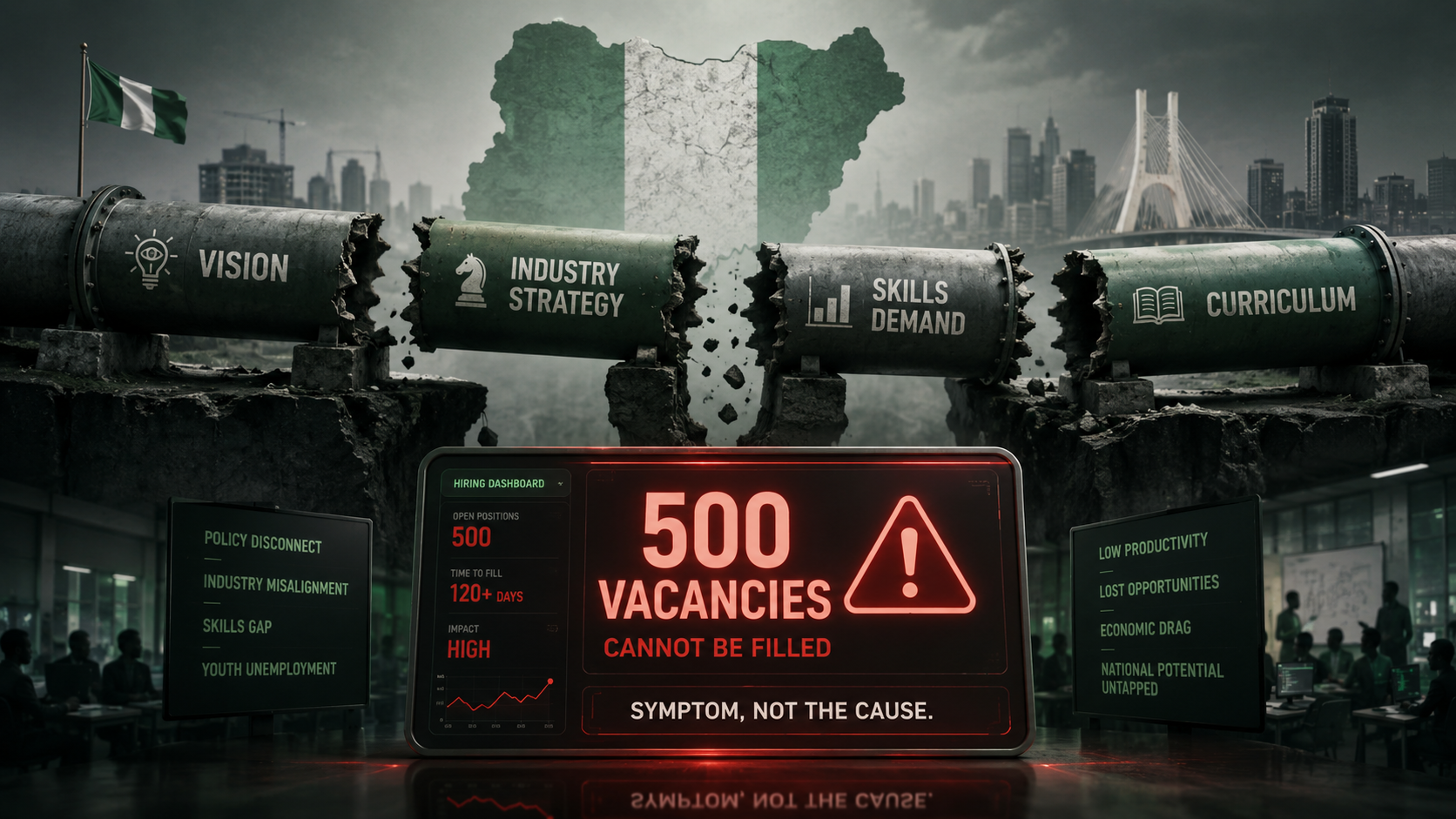
For two weeks, Nigerian commentators have argued over whether Tosin Eniolorunda is right that Moniepoint MFB cannot find 500 qualified Nigerians to fill its vacancies. I have read several commentaries, opinions, and research outputs. Each is responding to something real. But for me, the debate is being argued at the wrong altitude. The real question is not “where is the talent?” The real question is: what is the talent supposed to be for?

When a country commits to a long-term economic and industrial strategy, its education system must become the mechanism for delivering the necessary human capital. The curriculum, the skills pipeline, and the financing for training should not operate in a vacuum. They should be intentionally reverse-engineered from the ultimate goals of the national vision. That is how graduates are prepared for the future economy the country intends to build, making the education system fundamentally downstream of national vision. Three cases make the principle visible.

Continue reading
Standard
Academia, Education, issues, Networking, University

LEVERAGING ACADEMIC NETWORKS FOR CAREER EXCELLENCE

Applied Knowledge is Power

A paper presented at the “Town and Gown” Series at the Department of Political Science and International Relations, Covenant University, Nigeria.

Knowledge is power. So goes the popular maxim, which has been severally explored and tweaked in various ways that sometimes we fail to fully deconstruct its essence and practically explore the functional relationship between knowledge and power. While knowledge, on the one hand, is nearly impossible to quantify, its effect on human life is totally verifiable and measurable.

On the other hand, power is quantifiable but its effect is sometimes very hard to measure. Though power can mean different things, we are limited in this discourse to the framework of power as professional competence and the capacity to effect change in any area of human endeavor. It is the marriage of knowledge and power that forms the theoretical basis of my offerings in these thoughts.

In restating the premise of my thesis that knowledge is power, I consider Steve Fuller’s conceptualization of knowledge as “positional good” to be profound enough to terminate this thought. This is in the sense that knowledge expands or extends “the knowers possibilities for actions by contracting the possible actions of other”. If I know what you know, then you have no advantage over me, except in the case where we also have to measure the application of such knowledge. But if I know what you do not know, then I am elevated in advantage. So, yes. Knowledge does confer on one extended possibility for actions that sets one at advantage over others.[1]

Continue reading

Standard