Education, issues, Naija, Personal Development, Politics, University

Why Nigeria’s Workforce Debate Is Stuck at the Wrong Altitude

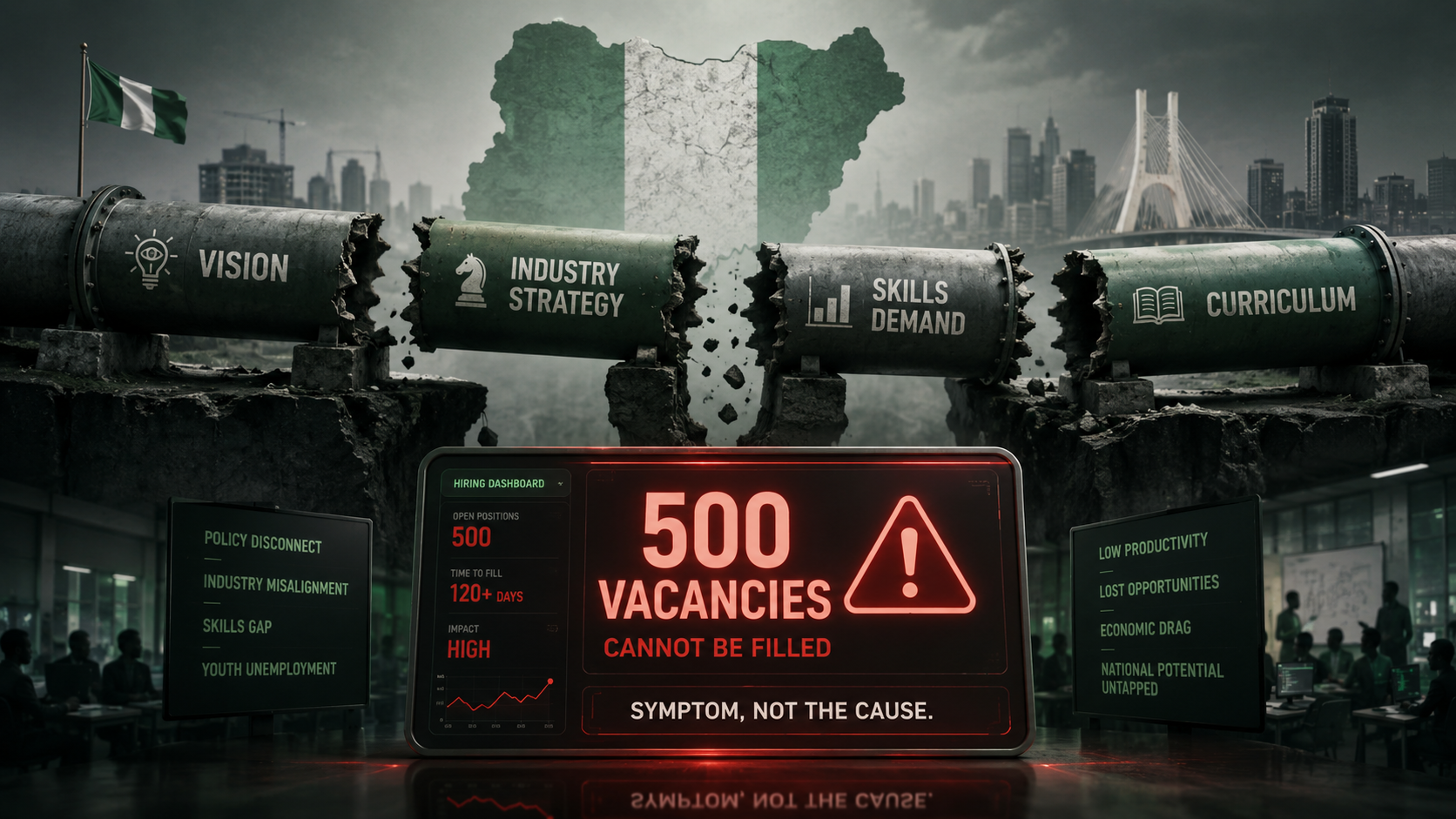
For two weeks, Nigerian commentators have argued over whether Tosin Eniolorunda is right that Moniepoint MFB cannot find 500 qualified Nigerians to fill its vacancies. I have read several commentaries, opinions, and research outputs. Each is responding to something real. But for me, the debate is being argued at the wrong altitude. The real question is not “where is the talent?” The real question is: what is the talent supposed to be for?

When a country commits to a long-term economic and industrial strategy, its education system must become the mechanism for delivering the necessary human capital. The curriculum, the skills pipeline, and the financing for training should not operate in a vacuum. They should be intentionally reverse-engineered from the ultimate goals of the national vision. That is how graduates are prepared for the future economy the country intends to build, making the education system fundamentally downstream of national vision. Three cases make the principle visible.

Continue reading
Standard
Politics, Naija, issues

Reforming Nigeria’s Asset Privatization Approach

I came across a post on X recently that sent me back to the troubled history of Nigeria’s privatization programme.

It reminded me of the 2003 NITEL-Pentascope scandal. NITEL, Nigeria’s state-owned telecommunications company, was not just another public enterprise. It was responsible for critical national infrastructure, including Nigeria’s access to the SAT-3 undersea cable, a major artery for international connectivity.

Yet NITEL was handed over to Pentascope, a Dutch firm that was barely a year old, reportedly had only eight employees, including the janitor, and had no serious experience managing a major telecommunications company.

Within a year, NITEL moved from a ₦15 billion profit to a ₦19 billion loss. More than 250,000 homes reportedly lost their phone lines. It was not a complex failure. It was a failure hiding in plain sight.

For me, Pentascope is not just a bad chapter in our telecoms history. It is the perfect lens through which to examine many of Nigeria’s privatization heartbreaks: ALSCON, Ajaokuta, Delta Steel, and the 2013 power sector unbundling.

In that same X thread, someone argued that Nigerians should simply “move on” from these failures. It reads like an innocuous statement from a frustrated citizen, but never a good idea. Moving on without understanding what went wrong is not closure. It is willfully inflicted amnesia, acting mature. Nations that forget their policy failures do not heal from them. They repeat them, and usually at a higher cost.

Continue reading
Standard
issues

YOUR COMING CRISIS

There is a coming crisis. Whether you are an individual, family, institution, or community. It is already taking shape, but you are ignoring it right now because the solution looks insignificant.

History and experience show us that the disasters we face, whether in our personal lives, families, businesses, faith, or society, rarely emerge suddenly. They are often the result of small, ignored actions that seemed too trivial to matter.

I recently tried to rewatch James Cameron’s Titanic and understood a few more details I never considered. Before its infamous collision with an iceberg in April of 1912, there were several warning signs. The ship’s crew received multiple iceberg alerts from other vessels, yet these warnings were either dismissed or not properly relayed. Even a tool as small as binoculars was not given to the lookout, who eventually shouted, “Iceberg!”.

The ship was also designed with fewer lifeboats than needed, a seemingly small decision justified by aesthetics, overconfidence, and merely obeying the legal requirements. Had these “insignificant” details been handled differently, the scale of the disaster might have been mitigated.

This pattern repeats itself in companies that ignore simple information “insignificant employees” may have or dismiss shifting market trends, in individuals who neglect their health until it becomes a crisis, or in leaders who avoid uncomfortable but necessary conversations until trust is broken beyond repair.

What is that “small” action you’re putting off? A five-minute call to check in with a key client? A difficult but necessary conversation with a loved one? A decision to upskill before your job becomes obsolete?

The future is shaped by the small decisions we make today. We shouldn’t wait for a crisis to prove what should have been obvious. The insignificant action we take now could be the lifeline that saves us later. Our crisis prevention should start today.

Question: What small but important action are you delaying to take right now?

Standard