
Education, issues, Naija, Personal Development, Politics, University

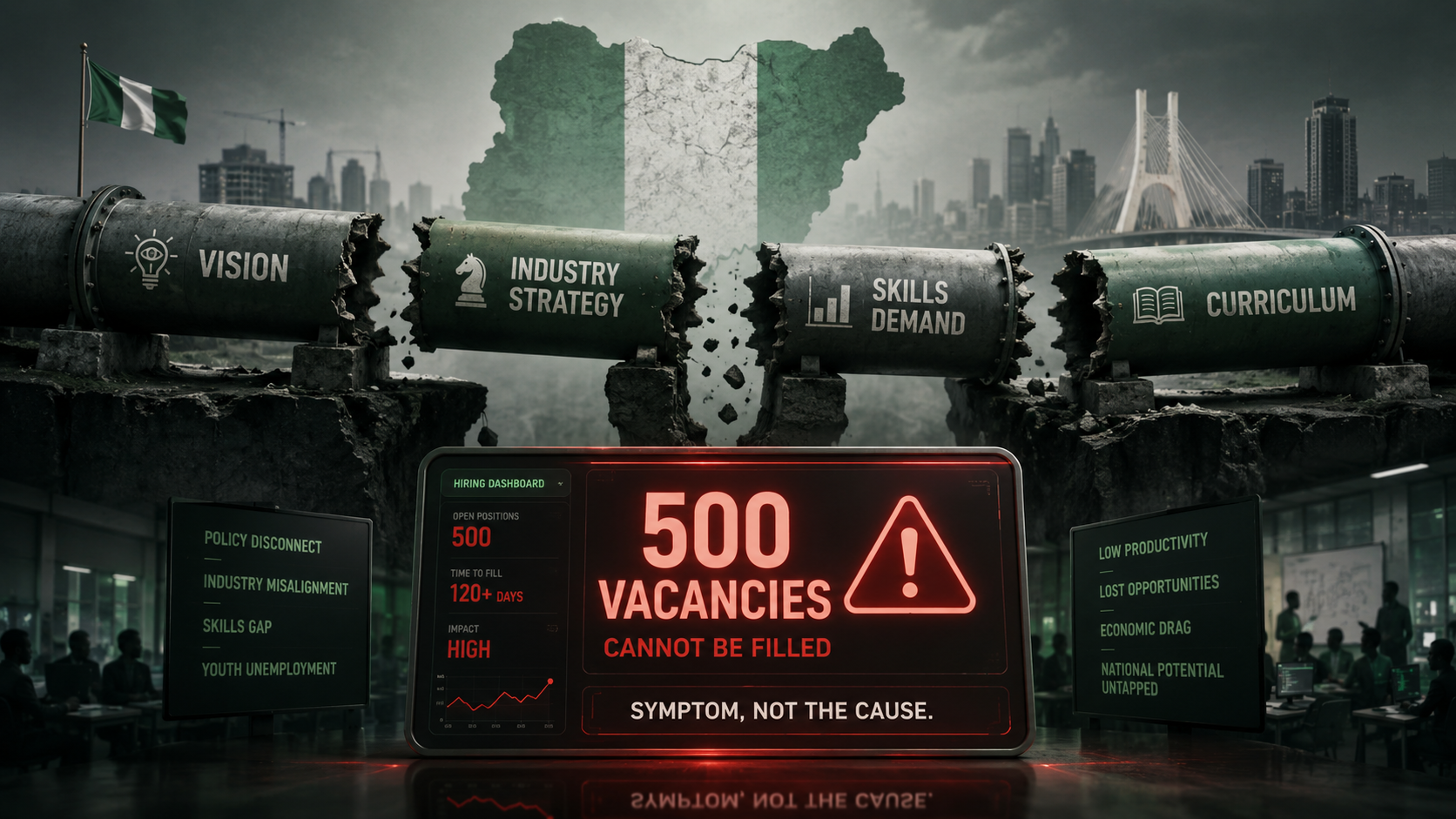
Why Nigeria’s Workforce Debate Is Stuck at the Wrong Altitude

For two weeks, Nigerian commentators have argued over whether Tosin Eniolorunda is right that Moniepoint MFB cannot find 500 qualified Nigerians to fill its vacancies. I have read several commentaries, opinions, and research outputs. Each is responding to something real. But for me, the debate is being argued at the wrong altitude. The real question is not “where is the talent?” The real question is: what is the talent supposed to be for?

When a country commits to a long-term economic and industrial strategy, its education system must become the mechanism for delivering the necessary human capital. The curriculum, the skills pipeline, and the financing for training should not operate in a vacuum. They should be intentionally reverse-engineered from the ultimate goals of the national vision. That is how graduates are prepared for the future economy the country intends to build, making the education system fundamentally downstream of national vision. Three cases make the principle visible.

Continue reading
Standard
Politics, Naija, issues

Reforming Nigeria’s Asset Privatization Approach

I came across a post on X recently that sent me back to the troubled history of Nigeria’s privatization programme.

It reminded me of the 2003 NITEL-Pentascope scandal. NITEL, Nigeria’s state-owned telecommunications company, was not just another public enterprise. It was responsible for critical national infrastructure, including Nigeria’s access to the SAT-3 undersea cable, a major artery for international connectivity.

Yet NITEL was handed over to Pentascope, a Dutch firm that was barely a year old, reportedly had only eight employees, including the janitor, and had no serious experience managing a major telecommunications company.

Within a year, NITEL moved from a ₦15 billion profit to a ₦19 billion loss. More than 250,000 homes reportedly lost their phone lines. It was not a complex failure. It was a failure hiding in plain sight.

For me, Pentascope is not just a bad chapter in our telecoms history. It is the perfect lens through which to examine many of Nigeria’s privatization heartbreaks: ALSCON, Ajaokuta, Delta Steel, and the 2013 power sector unbundling.

In that same X thread, someone argued that Nigerians should simply “move on” from these failures. It reads like an innocuous statement from a frustrated citizen, but never a good idea. Moving on without understanding what went wrong is not closure. It is willfully inflicted amnesia, acting mature. Nations that forget their policy failures do not heal from them. They repeat them, and usually at a higher cost.

Continue reading
Standard
issues

AI Isn’t Disrupting Consulting. It’s Exposing It

Over the past few months, I’ve watched an organization I serve make a quiet but significant shift. I am even seeing this in the government sector as well.

After reviewing several proposals from boutique consulting firms for an information management solution, proposals that would have cost six figures with the usual phased deliverables and ongoing advisory fees, they chose a different path. They’re building it inhouse with AI tools. At a fraction of the cost.

This wasn’t a budget cut. It was a strategic decision. Their position was why pay consultants for something we can now do ourselves?

And they’re not alone. What I’m witnessing isn’t isolated.

Organizations around the world that once relied on consultants for feasibility studies, compliance frameworks, and strategic documentation are increasingly asking: What are we actually paying for here?

The answer, in many cases, is uncomfortable: repackaged research and formatted insights they could now generate themselves.

Continue reading
Standard