
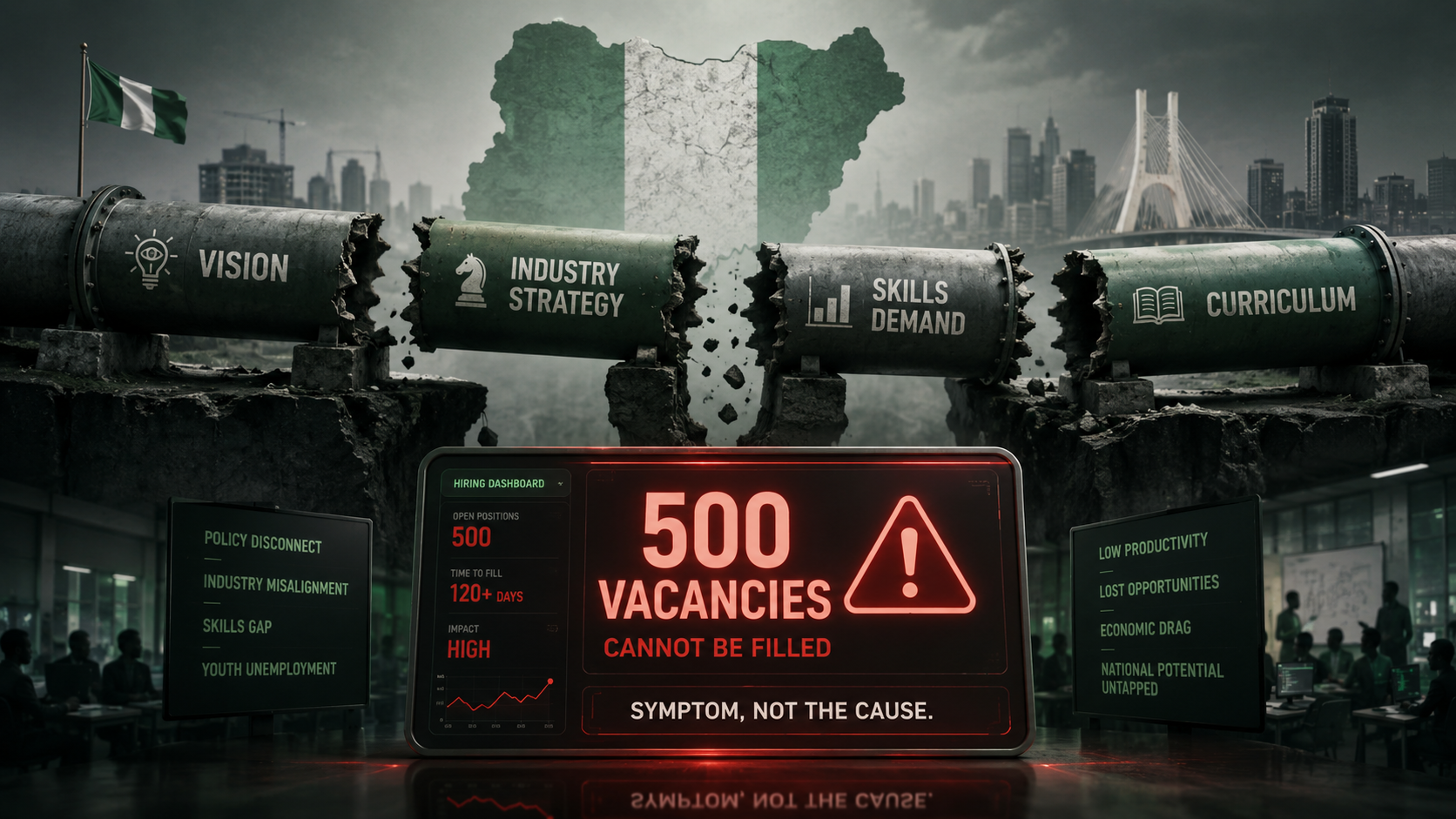
For two weeks, Nigerian commentators have argued over whether Tosin Eniolorunda is right that Moniepoint MFB cannot find 500 qualified Nigerians to fill its vacancies. I have read several commentaries, opinions, and research outputs. Each is responding to something real. But for me, the debate is being argued at the wrong altitude. The real question is not “where is the talent?” The real question is: what is the talent supposed to be for?
When a country commits to a long-term economic and industrial strategy, its education system must become the mechanism for delivering the necessary human capital. The curriculum, the skills pipeline, and the financing for training should not operate in a vacuum. They should be intentionally reverse-engineered from the ultimate goals of the national vision. That is how graduates are prepared for the future economy the country intends to build, making the education system fundamentally downstream of national vision. Three cases make the principle visible.
Singapore launched SkillsFuture in 2015 under its Ministry of Education, on the premise that the country’s only natural resource is its people. The instrument that drives it is the Industry Transformation Map. Sector by sector, the government identifies where the economy is going, what skills those destinations require, and reverse-engineers the training pipeline. Children encounter the framework from age eleven.
South Korea announced the Heavy and Chemical Industries Drive in 1973. KAIST, the country’s flagship technical institute, had been founded two years earlier to staff that vision. The vision survived four governments and outlived its political authors because it was institutionalized, not personalized.
Not far from Nigeria, Rwanda launched Vision 2050 in December 2020 to succeed Vision 2020. In February 2025, the Minister of Education announced that Rwanda was rewriting its 2003 education policy specifically to align it with the new vision. The chain is plain and visible. Vision sets the destination. Education policy updates to match.
In each case, the flow is the same: vision → industry strategy → skills demand → curriculum. Education does not lead. Education follows.
Nigeria has produced more than seven major national vision and planning documents since the return to democracy in 1999. Vision 2010 carried over from the military era. Then NEEDS. Then Vision 20:2020. Then the Transformation Agenda. Then the Economic Recovery and Growth Plan. Then the National Development Plan 2021–2025. Then the Nigeria Agenda 2050. Now, the Renewed Hope Agenda and the Medium-Term National Development Plan 2026 – 2030, which is under construction. Not one has been honoured by its successor with the discipline of continuity.
Nigeria Agenda 2050 was approved by the Federal Executive Council in March 2023. It is a 243-page, 30-year perspective plan organized into 26 chapters across six parts. It targets nominal GDP of $11.7 trillion and per-capita income of $33,328 by 2050. It is the live national vision.
The National Policy on Education in force today is the 2013 sixth edition. It was written a decade before NA-2050 existed. The vision was rewritten. The policy meant to produce its workforce was not.
In chapter 14 of the document, the vocabulary on education is comprehensive: transformational education, 21st century skills, STEM, digital literacy, and vocational pipelines. The financing instruments are substantive too: Build Nigeria Bonds for school infrastructure, expanded TETFUND research funding targeting ₦400 billion a year by 2050, a 4–5% of GDP budgetary floor, scholarship and loan revival, teacher pension reform, and more.
What the chapter does not do is articulate how education connects to the other sectors. NA-2050 has chapters on manufacturing, agriculture, the digital economy, science and technology, oil and gas, solid minerals, financial services, tourism, and more. None of those sectoral chapters is translated into a talent-demand specification that education then promises to deliver against. In the agenda, education builds capacity in a vacuum.
The entire industry-education coordination architecture in NA-2050 sits in one bullet on page 146: educational policies and curriculum will be “aligned with current industry and development needs.” That is the sentence. No coordinating body. No cycle. No specification of which industries, what skills, or on what timeline. No statutory mechanism that survives political transition.
This is the difference between Singapore and Nigeria. SkillsFuture is not an education program. It is a coordination layer between national industrial strategy and the education and training system. Nigeria has the funding instruments but doesn’t have the coordination layer.
The current talent debate is happening inside this gap, and every voice in it is responding to a different consequence of the same hollow.
In my view, Eniolorunda’s 500 vacancies are the operational symptom. The vacancies exist because the curriculum was never coordinated with the fintech sector’s senior-skill demand profile, because that profile was never specified at the national policy level.
Jonathan Millard’s wage analysis, in which Nigerian banks pay 5 cents per revenue naira to staff while JPMorgan pays 29 cents, is the price-signal symptom of the same gap. In an economy with no national vision that forces firms to treat talent as a strategic asset, cost-minimization wins by default.
Subomi Plumptre’s recruitment redesign at Sonderplace, using CEO-led interviews and paid fractional trials, is the firm-level adaptation. It is private capital absorbing the cost of a public coordination vacuum.
Dr Oludayo’s Nathan Leadgate Readiness Surveys, spanning 2017 to 2019, document that workplace-readiness gaps have been measured longitudinally for nearly a decade. This is not new. The diagnosis is on the record. What is missing is the connection between diagnosis and a national vision that explains what readiness is supposed to be readiness for.
There are different pools of Nigerian talent. A general pool that applies broadly. A self-directed pool that targets specific roles. A character-strong pool the credentialed market filters out. The pools are not the problem. The problem is that no economic vision has specified which pools matter for which sectors, in what proportions, and on what timelines. Nigerian employers compete for an ill-defined senior pool. Nigerian universities produce graduates against curricula calibrated for an economy that no longer exists. The two pipes do not meet because no document tells them where to meet.
This is not the fault of any single administration. It is a structural pattern that has outlasted every Nigerian government in the Fourth Republic. Each new vision document replaces the last. The education policy framework underneath does not move with it.
The world has not been waiting. Artificial intelligence is restructuring entire job classes faster than national curricula can be updated. Fintech, biotechnology, renewable energy, and advanced manufacturing are each producing, somewhere else, the senior talent layer that Nigerian firms now complain they cannot find here.
All I am trying to say is that a vision that does not survive its author is not a vision. A reform that is not coordinated with a vision is merely political theatre. An education policy that predates the vision it is meant to serve is, at best, passive inheritance.
I must be honest to say that I do see glimmers of hope from some of the strategic moves by the current Minister of Education, Dr. Maruf Tunji Alausa. However, if Nigeria does not sit down, across administrations, across sectors, across institutions, to articulate what it intends to become and what talent will be required to build it, the country will keep reacting to a world too dynamic for traditional systems to catch.
Selah.
 Thoughts of a Calabarboy.