
I do not necessarily believe that the best students make the best teachers. But there are some qualities about being an outstanding student that also qualifies one for the amiable profession of teaching, and these include discipline and commitment. The capacity to focus on one thing and stay the course with excellence in view is of great value to the ability to impart knowledge and facilitate the learning process. But really, it seems that the labor of the mind under the midnight oil is mostly motivated by the potential to earn big, and earn pretty big after college. Much of what is on the mind of the average student is how to escape the hold of poverty. So coming out and ending up a teacher is not exactly a satisfying thought. This is a growing problem in many developed countries, with widening income differences and increasing poverty levels. But how severe this is in least developed and developing countries. The students in these poor countries are told and taught that education is a means through which they escape poverty. Now it is getting rather difficult to convince students in a country like Nigeria to take up a teaching profession after getting a degree. So we end up having the perceived “organizational rejects” as teachers, lacking any iota of motivation to stay in the classroom. Continue reading
Tag Archives: Nigeria
NIGERIA AT 50: ARE THE “BEAUTIFUL ONES” YET BORN?
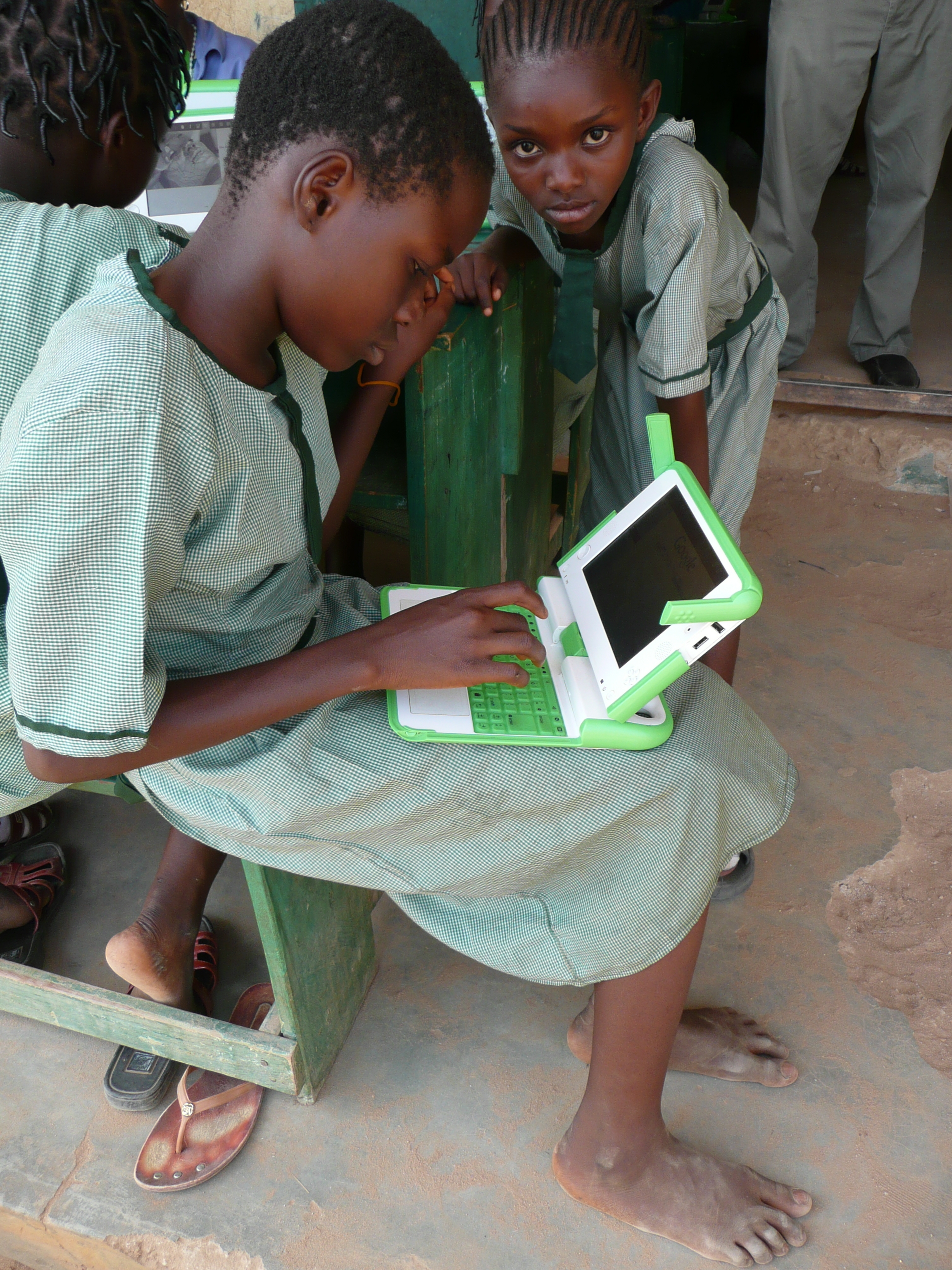
Photo by One Laptop per Child
One great advantage of personification is that it helps reduce an abstract entity to a relatively understandable concept. When we use the word “She” to refer to a country, it is because we can append certain human characteristics in assessing its existential issues. This traps complexities into units that the mere mind can comprehend and so pass due judgments. When we say Nigeria is 50 years old, it could be totally lost on us if we do not appropriately personify the country to understand the troubles it faces as well as the gravity of such. Perhaps if we can imagine for a moment a 50-year-old woman who has been severally raped, duped, blackmailed, and wasted, yet still lumbering on a dark road, then we may understand what the country has been through. How many persons of that age would suffer such dehumanization and yet remain composed and pretend to be fine? That is the best way to capture the past 50 years of Nigeria’s existence, or I should say recent history. And worse still is the fact that the woman is still undergoing an immoral bludgeoning by wayfarers and vile caretakers whose bellies and ambitions are their primary concern. So one wonders then for how long her pretense will last without an implosion.
Today however, an encouraging fact to know is that there is an awakening among Nigeria’s children. Silently, many voices are starting to cry out for change, while steadily there is growth in loyalty, like that of a young husband, within the precincts of her communities. Also there is the rise of an army of technical competence within her young population (disputed by many); an army equipped with the overflows of a globalized world running fast on the cyber lanes. This is one comforting detail I look to when forecasting the trajectory of Nigeria’s growth and development in all sectors.
But I fear. I fear because there lies an apparent disconnect between the visions of these progressive ones and those who hold or seek hold power. A greater fear for me is that more of the “Beautiful Ones” are succumbing to the rot in the system and getting anesthetized by the need to be successful. Those who have stepped out to see the workings and possibilities of other societies have become frustrated and their frustrations are further marinated by the already existing tangible angst on the streets. It sometimes feels like we have lost the present generations to a calamitous decadence, to the point that even the unborn child harbours the seeds of national iniquity. Not only that, but it feels as though we received nothing good from the generation before and then lack the capacity to pass anything good to the generation ahead.
Continue reading
Nigeria’s Goodluck: No Violence Over Presidential Bid
Nigeria will not fall into violence over his decision to stand for elections next year, President Goodluck Jonathan said in an exclusive interview with CNN. “I can tell you very clearly that violence will not break out because of my interests. I can tell you very clearly,” Jonathan said in a wide-ranging interview at the presidential palace in Abuja ahead of October 1 celebrations marking 50 years of independence.
In September, Jonathan declared his intention to run in the October presidential primaries for his party, the People’s Democratic Party. Under Nigerian “zoning” rules, power must rotate between the north and the south every eight years. Jonathan — a native of the Niger Delta region in the south — was vice president under President Umaru Yar’Adua, from the north, when he died in May three years into his first term. “In the first place if this country had agreed the presidency rotates between north and south I would not be the president today. I couldn’t have been if there is an agreement in this country that it rotates between north and south,” Goodluck reasoned. “I couldn’t have been the president the day Yar’Adua died — another northerner would have taken over and I could have continued as the vice president. Goodluck acknowledged that Nigeria is grappling with limited resources, corruption and high poverty, despite being a world leader in oil production.
However, he said, “one thing that I know and I feel Nigeria will celebrate is continuity and peace. Yes we experienced civil war that lasted 13 months. Some other countries experienced civil wars that lasted for years.”
Vodpod videos no longer available.

