issues

THE POWER OF AFRICAN PROVERBS

I have sat through merciless lectures on philosophies, concepts, paradigms and have tried to unravel the zeitgeist of European or Western minds, all to still be wanting in the basic understanding of my own people and their customs. The ideas we spend time studying back in school and even today, subtly, in the books we read, are all like one taking a medication to treat another man’s headache. Whereas we have our own medication in the ideologies of our traditional proverbs, we have abandoned them and now look like orphans in global circles. So we have set off to scavenge on foreign convictions to treat our local predicament. If my friends can not do the eating to assuage my own hunger, because only me can feel the grumblings of my stomach, how then do we assume that we can build our houses on other people’s foundations?

The internal configurations of any given society is determined by its history, culture, and geography. Thus to understand such people, you must necessarily look through these stated factors. So also is the process of identifying what raw materials must be employed in building the foundations for a sound society devoid of contradictions that clog the wheels of progress. Of course one should be wary of the quality of materials used in constructing a lasting national identity, because foundations matter, and this is what I believe we must have a rethink on the way we have built our so far.

There is nothing wrong with looking outside to understand inside, but there is no truth higher than the fact that powdering your face does not stop bad breath. Some issues that belie personal worth are self discovered and self propagated. Thus, in articulating a system that works for our people and ensuring that we engineer a proper mechanism for assimilating genuine values in our present and coming generations, we must be bold to collate and document the wise sayings of our people. We must build the conceptual framework of progress in every facet of our community: governance, relationships, education, family, etc. on these invaluable philosophies which have been captured by the sages in our history. I am of the opinion that the minutiae of our value system should be founded upon laid these laid down conceptions like the Indians, Chinese, Greeks, and Arabians have all done.

In not belabouring the matter, but leaving it to the simple judgements of the reader, I will henceforth in subsequent notes simply try to highlight some of the very sound and cross cutting African proverbs that I have come across in recent times. I have meditated on a bunch of them and found lots of truth therein. So I share one here that is of Zulu origin:

‘IN COPYING EVERYONE ELSE ALL THE TIME, THE MONKEY ONE DAY CUT HIS THROAT’

This proverb may evoke jocular responses and discussions, but there is no overstating the fundamentals of this statement. I actually saw a young man who was so enamoured by the life of a renowned expert to the point that he followed closely on the habits of the man. Unknowingly to him, his capacity to manage such high level scheduling was limited and he only realized, after experiencing a breakdown, that he ought to have first dealt with the details of hard work before launching into the dangerous waters of an active work life. This, as evident on this individual platform, is very obvious at the State level. Nations have sought to implement the successful ideologies of other nations to their own detriment. Those nations, like the Monkey forgot that others had a throat of steel which could not be cut or broken, thus committing suicide by attempting to ape others.

I give a classic example in many African nations of the sweet but noxious waters of Capitalism. While Adam Smith’s idea has arguably created a good life for many Western nations, the rush to adopt this system in many African countries has created the extremities of wealth and poverty. While capitalism itself is not an evil harbinger, those courting its provisions must be sure that internally, such structures that ensure its success are well entrenched. This Zulu proverb therefore guides our thinking in knowing the frequency of adapting foreign ideas to our local needs.

As I am writing this note, I am sitting here in conference room four in the UN building at New York and listening to representatives of countries adopt a common policy on the prevention, combat, and eradication of illicit trade in Small Arms and Light Weapons. Iran is proving a tough negotiator by delaying the consensus and this is evoking responses of rationality from some States for Iran to see reason. Suddenly my boss, representing the Nigeria and the Africa group takes the floor and suavely declares to all: “My people say that goat meat is sweet but takes long to roast. So while we are roasting it, what will the children eat?” In a powerful swing of events, that statement swayed the entirety of the delegates to sing in one voice against Iran. After the meeting so many throng his seat to express the love for his wise sayings, and frantically adjusting his ‘parachute’ (babariga), he struggles to shake all the hands being stretched towards him, while keeping a line of African delegates waiting to discuss further.

Please don’t tell me African proverbs are obsolete or shallow, for with it I am carving a path to a fresh understanding of the world around me, and I am so determined to inspire those around me to “look to the rock from whence we were hewn.” In the words of a Ghanaian proverb: “se wo were firi na wo san kofa a yenchi”, which literally means “it is not taboo to go back and fetch what you forgot”, I am going back to my roots to seek the basket of wisdom God has so heavily endowed us with. For so my uniqueness and true contribution to a new and meaningful living will begin.
Standard
issues

ESCAPE ROUTE TO UNCERTAINTY

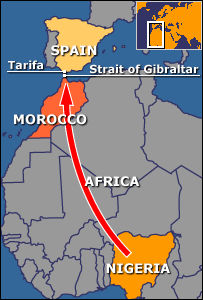
I was dismayed this morning when I heard the news of some Nigerian illegal migrants who died in a boat mishap off the southern coast of Spain. They were of course trying to get into Spain, about a 100 of them including 2 pregnant women. As at now only 23 have been rescued and over 60 confirmed dead. In such a situation who do we begin to blame or what do we place the blame tag on? This is a simple indication that if a 100 met their Waterloo in a bid to find a better life, probably a 1000 or more make their way illegally across to uncertainty.

We keep hearing of the Spanish government deporting sending back several boats attempting to cross over and even deporting those that made it. We must remember that these desperate individuals have already lumbered their way through the sahara deserts, determined to reach the land of the golden sun. What pushes these individuals or what draws them seems to be agreeable by all those who hear of their fate: Nigeria has nothing to offer them thus it behoves upon them to seek a better life where it can be found, by hook or crook. You can be sure that this is one singular explanation you can get all Nigerians to agree on.

From my recent musings however, I have taken time to rethink many of the circumstances which Nigeria presents to those who wish to analyse its issues. And this issue of illegal migration is certainly one of which I choose not to approach as common as we have before time made it seem. There is something beyond the discordance in the nation that acts as a push or pull factor for these individual who seek every possible tunnel of bolting. I agree that the life across may be lush and that behind harsh, and those this may be a necessary condition but is it sufficient for dare-devil acts such as these?

Leaving one condition for another should be predicated on the satisfactory knowledge of what obtains in the destination. But what I see is that this is not the case. Nigerians, heavily blinded by the quest to survive, abandoned the noble virtue of judgement and foolishly embark on a journey through an escape route to uncertainty. The argument or notion that Nigeria has to offer now is lame and at best simplistic. This is because in the last 4-5years, Nigeria ranks among the 20 countries in the world experiencing rapid growth. Opportunities are breaking forth and many are changing their status and class in society. With all its glaring short comings, in Nigeria there is currently the remoulding of a middle class and increasing number of upwardly mobile citizens are gaining entrance into the corridors of the economy.

The amount of foreign direct investment in Nigeria has shot up in recent times and both small and medium scale investors are leveraging their skills in a moist system. Any dude who is blind to these factors for growth and development, and is still seeking in ‘Sokoto’ what is the ‘Shokoto’, must be compared to the circus Elephant. While young men are exploiting openings in the economy and testifying to possibilities, others are numbed by sights and sounds of glamour and comfort, flashed by the western media. And like a persistent fly flirting with a hot bowl of pepper-soup, we know the probable end of these fleeing friends.

Let me state very clearly here that we are wiser now to know that nothing works for you except you work a it. Even when you find a system where everything works, it still will not deliver value to you until you plough through its provisions. Deception is at work in our young people. This is why many are ready to leave a present discomfort for uncertainty. It is amazing how much faith they have about succeeding in an uncertain future, but have no faith in the possibilities of the now, whereas both require the same level of internal convictions. So please can someone trap down their relations about to fall into the error of misguided judgement.

I will however not exonerate the government from this issue as well. While we still have unpatrolled borders and points of exits, we have also not looked at appropriate policies that will hold down young people from engaging in illegal immigration constituting a problem for other countries and further smudging the already hideous image of Nigeria. I know we have the capacity to absorb these individuals and make them have a meaningful existence, but what draws them is beyond what government can legislate on. So while I charge the government to make the country look better than where our children are escaping to, I also charge our children to stop risking their lives to find what they already have. If you care to till your earth you will find a life.

Standard
issues

RETHINKING EVERYTHING

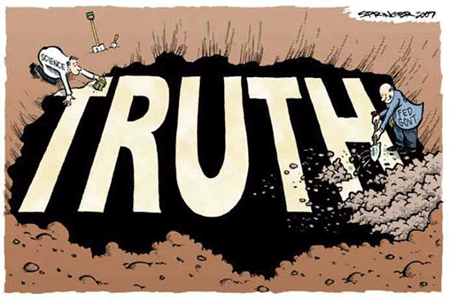
I risk sounding very simplistic, but I will go that path. Have you ever wondered about how everything you know emanated? Or have you ever pondered upon the real truth on what you presently know about the issues of life? Fret not! You aren’t alone on this. I can authoritatively tell you that most people at some point of their life question everything they know to see if they are firmly rooted on true principles worth believing, or they should carve out a new path for themselves. From our teenage years we begin a silent rebellion to the knowledge and rules that we grew up with, and some of us alter our path into dangerous territories that leave us with bad scars. Some of us successfully sieve through the muddy issues of what values we should accept as truth and which we should reject, while most of us only discover the truth after being battered by the faulty choices we made in our quest for real answers.

One truth I have come to see is that everything in life has an origin. What you presently believe about anything, has its origin somewhere, either in one man’s idea, or a collective agreement by some gathering. Let me give an example. In northern Nigeria, when men want to urinate, they stoop down to do this. And I asked myself why? I researched and found out that it is a practice with Desert Nomads, who for the sake of heavy desert winds have to stoop to prevent splashes. It became a practice embedded in culture and even religion because of the conversion of these tribe into Muslims, and with their territorial expansion and overarching influence everywhere you have Muslims now, it is the common practice. There the question is would a northerner be abnormal if he stands to pee? When these men visit where you only have toilet bowls, how would they do their thing?

Another example is this. In the Christian religion, we have always been told that it is a sin to drink alcohol or should I say it is perceived as unacceptable to take in alcohol. Are there no benefits in the substance called alcohol? With science showing benefits to this substance shouldn’t we be concerned with what level is beneficial and what level is dangerous? We know that even water, when taken in excess, has its side effects and this is also similar in alcohol? So how did we come about the most Churches banning the taking in of any form of alcohol? I once went for the burial ceremony of a friends dad on an empty stomach due to the early time of the day the occasion was slated. I was glad to partake of the communion that day and joyfully walked down the aisle to receive a portion of ‘Christ’s body and blood’. The problem came a few minutes later after drinking the ‘blood’. My eyes began to roll and I felt as though I had suddenly become taller or the ground had move further from me. Of course the communion wine was very alcoholic and my empty stomach did not receive it well. Did I come out of Church a sinner?

I was once invited for a private 10 man birthday lunch. The celebrants husband had just returned from pilgrimage to Jerusalem and brought one of the finest Palestinian wine, which has a history back to the time of Jesus. A little taste of that wine and I knew that one full glass can magically titillate ones senses. But somehow over the years, we have been passed down the concept that it is sinful to even put your tongue to it. Is this very true? Are we really walking in the truth with all the church traditions we know of? So much for Church…. you figure out the rest.

Today we have also grown up to know democracy as the most effective form of governance, because it gives more power to the people. But is this true? Does it really apply to a system of multi-ethnic people who are all scrambling for recognition and self-interest? Is democracy native to us as a people or is it a borrowed ideology from another society? Don’t we think we need a rethink on what leadership and governance is all about? What about money? Should we work for money? Should we strive to make all the money we can because we want to help other people?

What of education? Is a university degree or any education at all a necessary condition for success in life? Should everyone go to a secondary school or university? Do we have to study what we do in our tertiary institutions? Questions and questions and questions? I cannot exhaust them all. But I tell you, if you try to seek the answer to these questions you may have a conclusion that defies your current belief system. I challenge you to embark on a journey of seeking answers for yourself.

I will deceive myself if I say I can capture the entirety of my thoughts in this little piece. I am already experiencing a bloc in this write-up because some other things I want to mention are pretty controversial. However I want to stimulate your thought process in answering for yourself the questions that others usually answer for you. I am in the process of rethinking everything in my life to find true value in all my engagements. I cannot continue on the road whose origin is unknown to me, neither is the destination in my mental articulation. Within me I cannot afford to ignore the gently throbs for the truth on all that lies on my path.

My name is Reginald, and I am rethinking everything.

Standard