Career Development, Education, issues, Personal Development, Spiritual

The Gifts of Stagnation: Lessons in Stillness

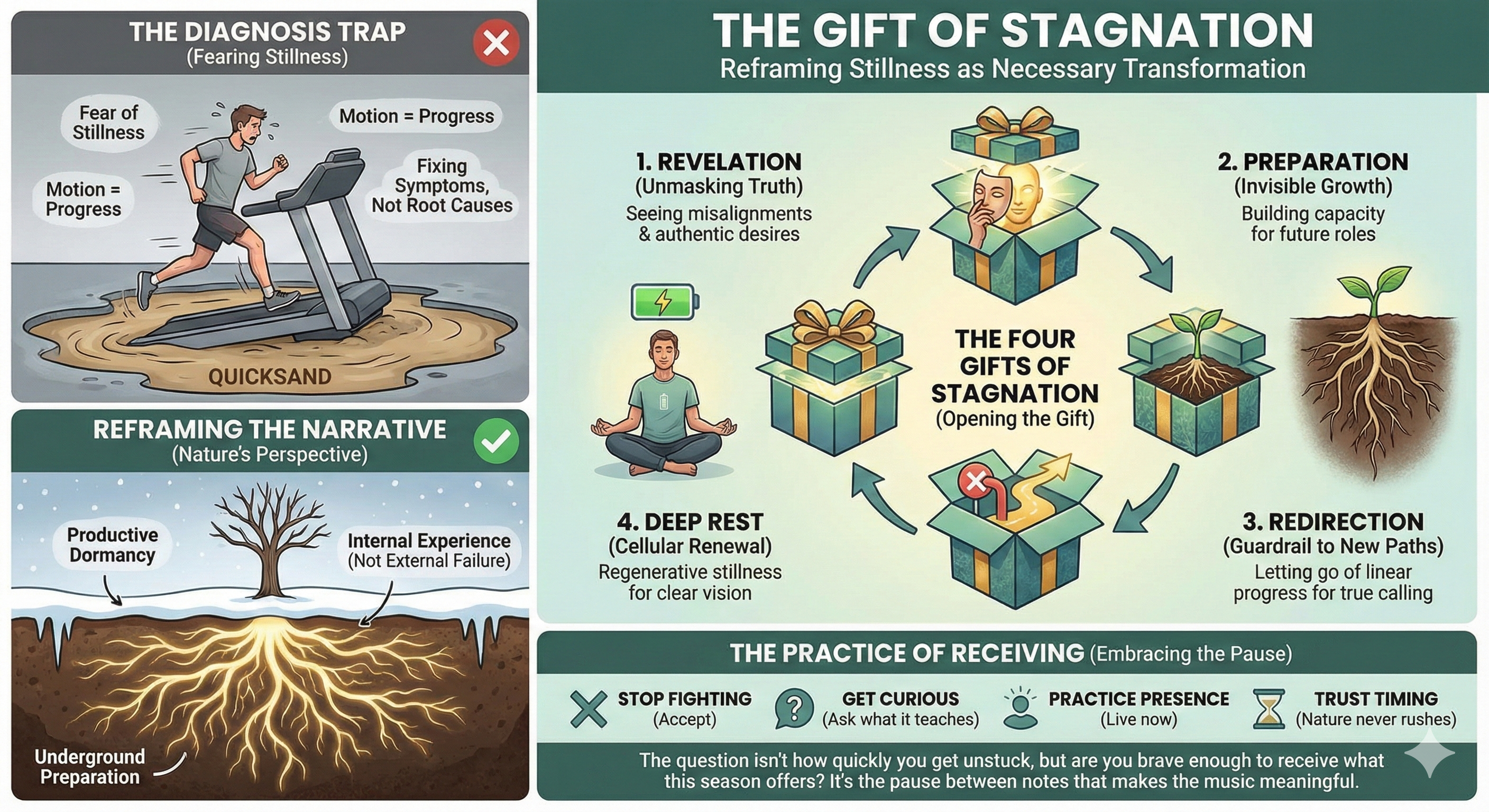
Last month, I invested some time in a call to a dear friend who described his life as “running on a treadmill in quicksand.” He had a great job, a stable income, and by external measures, was succeeding. Yet he felt profoundly stuck. The promotion he’d been promised kept getting delayed. The side project he was passionate about had stalled. Even his extracurricular activities felt routine rather than invigorating.

His story echoed dozens of similar conversations I’ve had recently. An entrepreneur friend whose business has plateaued after years of growth. A talented writer who hasn’t published anything for a while. A director-level professional who knows she needs to leave her company but can’t seem to take the first step.

What strikes me about these conversations is how quickly we often leap to solutions. New job. New city. New strategy. New relationship. We treat stagnation like a problem to be solved rather than a message to be heard. We become so focused on movement, any movement at all, that we miss what the stillness is trying to teach us.

Our culture has conditioned us to fear stillness. We equate motion with progress, busyness with importance, and constant growth with success. When we feel stuck, our first instinct is to identify the blockage and remove it.

Continue reading

Standard
issues

YOUR COMING CRISIS

There is a coming crisis. Whether you are an individual, family, institution, or community. It is already taking shape, but you are ignoring it right now because the solution looks insignificant.

History and experience show us that the disasters we face, whether in our personal lives, families, businesses, faith, or society, rarely emerge suddenly. They are often the result of small, ignored actions that seemed too trivial to matter.

I recently tried to rewatch James Cameron’s Titanic and understood a few more details I never considered. Before its infamous collision with an iceberg in April of 1912, there were several warning signs. The ship’s crew received multiple iceberg alerts from other vessels, yet these warnings were either dismissed or not properly relayed. Even a tool as small as binoculars was not given to the lookout, who eventually shouted, “Iceberg!”.

The ship was also designed with fewer lifeboats than needed, a seemingly small decision justified by aesthetics, overconfidence, and merely obeying the legal requirements. Had these “insignificant” details been handled differently, the scale of the disaster might have been mitigated.

This pattern repeats itself in companies that ignore simple information “insignificant employees” may have or dismiss shifting market trends, in individuals who neglect their health until it becomes a crisis, or in leaders who avoid uncomfortable but necessary conversations until trust is broken beyond repair.

What is that “small” action you’re putting off? A five-minute call to check in with a key client? A difficult but necessary conversation with a loved one? A decision to upskill before your job becomes obsolete?

The future is shaped by the small decisions we make today. We shouldn’t wait for a crisis to prove what should have been obvious. The insignificant action we take now could be the lifeline that saves us later. Our crisis prevention should start today.

Question: What small but important action are you delaying to take right now?

Standard
issues

LET’S TALK ABOUT FEAR

Here are three major fears you will have to overcome if you want to attempt at executing your mission on earth. They come in varying degrees and appear at different seasons of your life. Be conscious of them and how they subtly motivate your actions or inactions.

1. The fear of inadequacy. This is an internal condition that leaves you conceited about your true worth. It prevents you from even trying to conceive an idea or own an inspiration because you feel incompetent or unqualified.

2. The fear of failure. This is when your self-inflicted inadequacy meets an assumed unfavourable external condition. This fear makes you constantly look to the impossibility of things, thereby hindering your ability to even begin.

Continue reading

Standard