
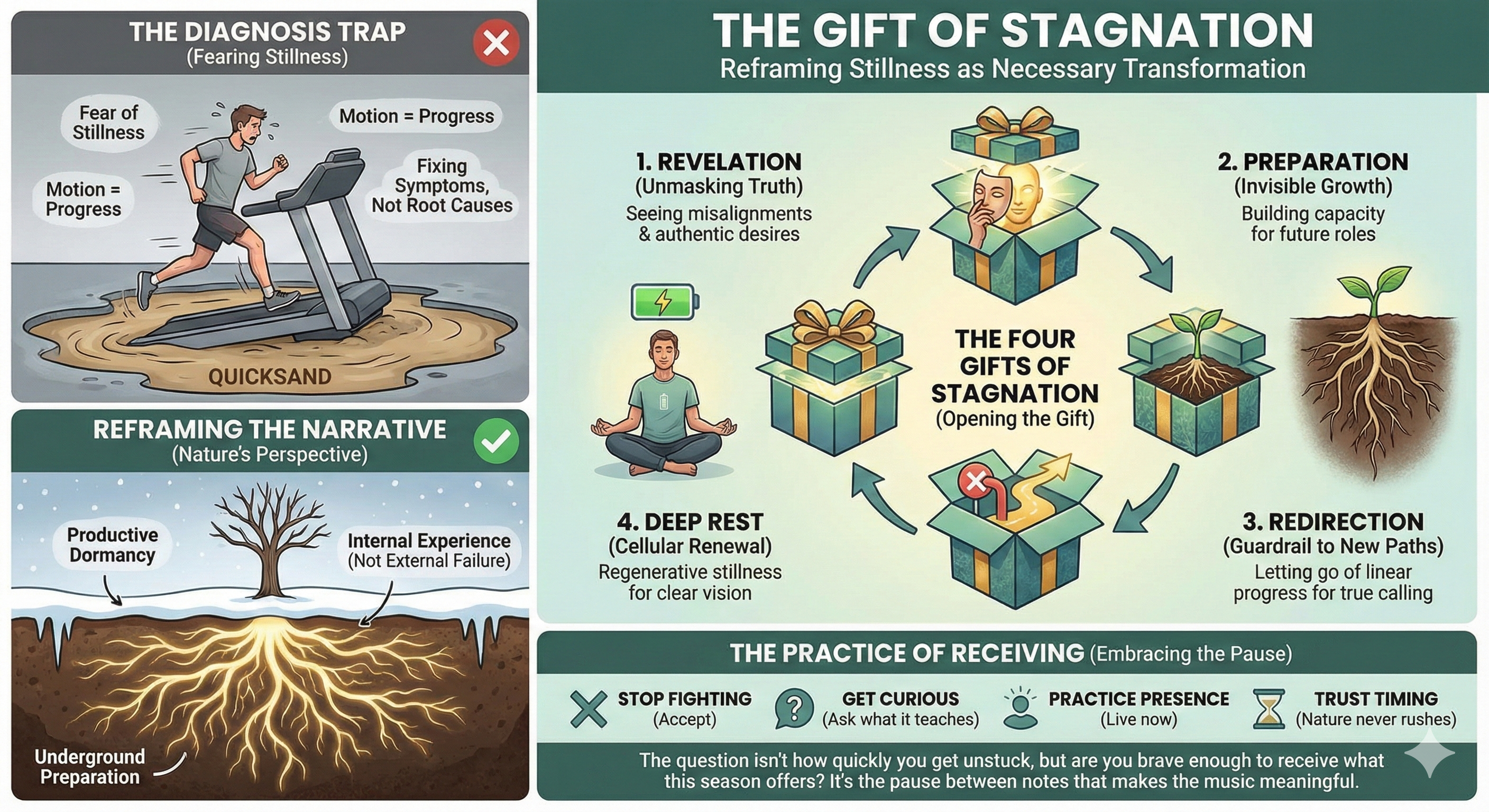
Last month, I invested some time in a call to a dear friend who described his life as “running on a treadmill in quicksand.” He had a great job, a stable income, and by external measures, was succeeding. Yet he felt profoundly stuck. The promotion he’d been promised kept getting delayed. The side project he was passionate about had stalled. Even his extracurricular activities felt routine rather than invigorating.
His story echoed dozens of similar conversations I’ve had recently. An entrepreneur friend whose business has plateaued after years of growth. A talented writer who hasn’t published anything for a while. A director-level professional who knows she needs to leave her company but can’t seem to take the first step.
What strikes me about these conversations is how quickly we often leap to solutions. New job. New city. New strategy. New relationship. We treat stagnation like a problem to be solved rather than a message to be heard. We become so focused on movement, any movement at all, that we miss what the stillness is trying to teach us.
Our culture has conditioned us to fear stillness. We equate motion with progress, busyness with importance, and constant growth with success. When we feel stuck, our first instinct is to identify the blockage and remove it.
But we often wrongly blame external conditions for internal problems. The executive who feels stuck in her role might immediately assume she needs a new job. But what if the stagnation is revealing a disconnection from her original purpose? The entrepreneur whose business has plateaued might think he needs better marketing. But what if the plateau is preparing him for a fundamental pivot he hasn’t yet imagined?
When we rush to diagnose and fix stagnation, we treat the symptoms rather than the root cause. We change jobs but carry the same patterns. We move cities but bring our restlessness with us.
Let me reframe things a bit. Stagnation is a paradox. It is an internal experience often completely disconnected from external reality. I want to offer a different lens through which to view this condition. Let me clarify quickly that I am writing here of developmental stagnation, the feeling of spiritual or professional arrest, not the systemic stagnation caused by acute poverty or survival crises, which require different interventions.
For those of us wrestling with purpose and direction, I believe stagnation is actually a gift. It is not life’s way of punishing you; it is life’s way of preparing you. From my experience, when one stops fighting against and starts listening to it, stagnation reveals itself as a master teacher, offering four distinct gifts we cannot receive while we are in motion.
So, let me examine these gifts one after the other in the foregoing.
First is the Gift of Revelation
Motion is a beautiful disguise. When we’re constantly moving, climbing the career ladder, building the business, or pursuing the next goal, we can avoid fundamental questions about who we are and what we actually want. Stagnation strips away this disguise.
In the unexpected stillness, revelations emerge. The professional who can’t seem to land the next role might discover that she’s been pursuing her father’s definition of success rather than her own. The artist whose creativity has dried up might realize he’s been creating for approval rather than expression.
One friend described it perfectly: “When I finally stopped thrashing against being stuck, I realized I wasn’t stuck at all. I was standing at a crossroads, but I’d been moving too fast to see the other paths.”
Stagnation reveals our misalignments. It shows us where we’ve been lying to ourselves, where we’ve chosen safety over authenticity. You can’t change direction if you don’t know you’re on the wrong path.
The Gift of Preparation
Nature understands something we often forget. It is that growth happens in cycles, not straight lines. Before spring arrives, winter holds the earth in productive dormancy. To the naked eye, nothing is happening. But underground, the root systems are strengthening to support the weight of the coming harvest.
Your season of stagnation is your “underground” season. You are developing capabilities you don’t yet know you’ll need.
I think of a colleague who spent two years unable to find a leadership role that fit. During those two years, she reluctantly took on consulting projects, learned new technical skills, and deepened her industry knowledge just to stay afloat. When the right opportunity finally appeared, she was prepared in ways she never could have anticipated. The “stagnant” years had been preparing her for a role that didn’t even exist when her journey began.
Preparation isn’t always visible. But when we look back, we often see that our seasons of apparent stillness were actually seasons of invisible transformation.
The Gift of Redirection
Sometimes a path ends not because we’ve failed, but because we’ve completed what that path was meant to teach us. This is why I strongly believe that stagnation acts as a guardrail, stopping us from continuing down a road that no longer serves us or the purpose we were created for.
Redirection requires letting go of our attachment to linear progress. It asks us to consider that going sideways, or even backwards, might actually be moving forward in a larger story we can’t yet see. It invites us to ask different questions. Instead of asking “How do I get unstuck?”, one might ask, “What wants to emerge through me now?”
A writer friend had been struggling for years to finish a novel. The more she pushed, the more stuck she felt. Finally, she put the novel aside and started writing short stories, something she’d never considered “serious” writing. Those stories led to a series, which led to a deal with an African Movie Channel, which led to a movie-making career. The novel’s stagnation had been redirecting her toward her true calling all along.
Finally, the Gift of Deep Rest
We live in a culture that has forgotten the value of rest. Not the collapsed exhaustion we call rest, but deep, regenerative stillness. Stagnation sometimes arrives as an enforced sabbatical, a mandatory pause that our soul requires but our ego resists.
This isn’t passive rest. It’s the kind of stillness where transformation occurs at the cellular level. Where old patterns dissolve through reengineered thought, and new possibilities emerge.
An executive I know hit a wall in his career and couldn’t push through. After months of frustration, he surrendered to the stagnation. He started meditating. He took long walks without podcasts. He read poetry for the first time since college. Six months later, without any forcing, a clear vision emerged for his next chapter, one that integrated parts of himself he’d abandoned in his climb to success.
The questions might arise as to how we unwrap these gifts, how we shift from experiencing stagnation as a curse to receiving it as a blessing. Let me lend a few thoughts, which are by no means exhaustive.
First, stop fighting. Recognize that your resistance to stagnation often causes more suffering than the stagnation itself. Practice a depth of awareness which resolves the fact that you are exactly where you need to be, even when you don’t believe or understand it yet.
Second, get curious. Instead of asking, “How do I fix this?” ask, “What is this season teaching me?” Pay attention to your dreams, your spontaneous thoughts, and your unexpected emotions.
Third, practice presence. Stop living in the future, where everything is fixed, and start living in the present, where everything is possible. Find small movements within the larger stillness. “Sufficient for the day is the evil thereof”.
Trust the timing. I’ll skip the many stories I can tell here, but learn this amazing truth from nature. It never rushes, yet everything gets accomplished. Consider that moving forward prematurely might actually set you back.
As I write this, I think of the friends and colleagues who inspired this piece, talented individuals who feel limited, and successful people who feel empty despite their achievements.
What I offer in this reframe is this: Your stagnation is not your enemy. It is an invitation into deeper understanding, truer alignment, and more authentic expression. The next time you feel stuck, resist the urge to immediately push through. Instead, pause. Breathe. Ask yourself what gift your stagnation is offering you. You might discover that you’re not stuck at all.
You might be in the most important phase of your journey, which I will call the “Pause Between Notes” that makes the music of your life meaningful, the rest between breaths that makes life possible, the stillness between movements that makes the dance beautiful.
The question isn’t how quickly you can get unstuck. The question is whether you’re brave enough to stay still as long as necessary to receive what the season has to offer.
 Thoughts of a Calabarboy.