

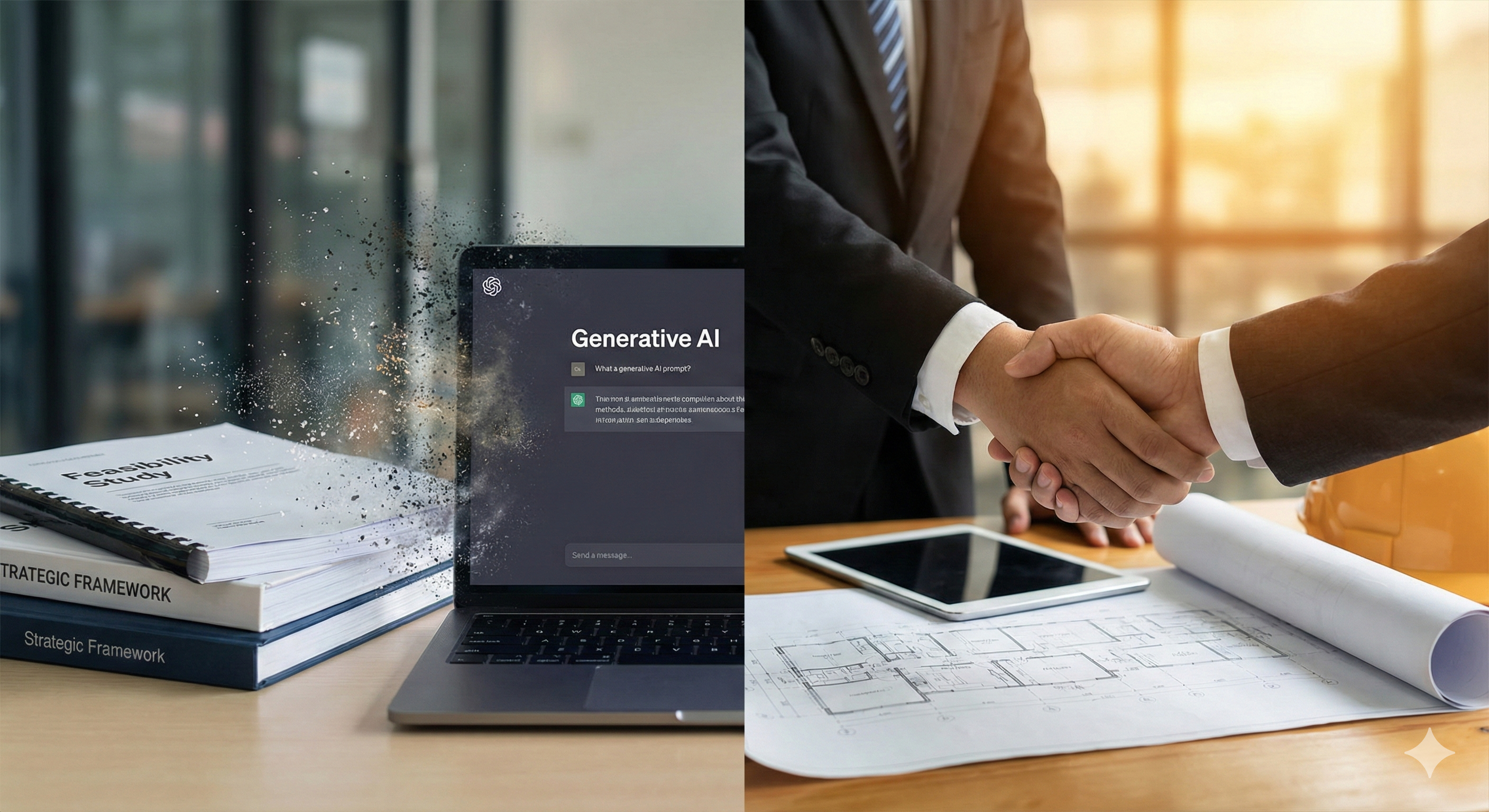
Over the past few months, I’ve watched an organization I serve make a quiet but significant shift. I am even seeing this in the government sector as well.
After reviewing several proposals from boutique consulting firms for an information management solution, proposals that would have cost six figures with the usual phased deliverables and ongoing advisory fees, they chose a different path. They’re building it inhouse with AI tools. At a fraction of the cost.
This wasn’t a budget cut. It was a strategic decision. Their position was why pay consultants for something we can now do ourselves?
And they’re not alone. What I’m witnessing isn’t isolated.
Organizations around the world that once relied on consultants for feasibility studies, compliance frameworks, and strategic documentation are increasingly asking: What are we actually paying for here?
The answer, in many cases, is uncomfortable: repackaged research and formatted insights they could now generate themselves.
The hard truth most folks aren’t saying out loud is that AI isn’t disrupting consulting. It’s exposing what was always true. If your value proposition can be replicated by a well-crafted prompt, you were never selling consulting; you were selling documentation services at advisory rates.
The consultants feeling existential pressure are those whose deliverables were desk research repackaged as “market intelligence,” template-driven frameworks, or compliance checklists presented as strategy.
None of that required deep expertise. It required access to databases, templates, and time. AI just made that access universal.
IMHO, what survives is what AI can’t do, and that is EXECUTION!
AI can tell you what regulatory approvals you need. It can’t navigate the political dynamics and institutional relationships required to get them.
Also there is the challenge of judgment in ambiguity. AI generates options. It can’t make high-stakes decisions when data is incomplete, stakeholders contradict each other, and risks are institutional.
As for proprietary networks, I mean not just knowing who to call, but being the only one who can, with the credibility to make it matter, it will be a very high VP.
In the transition ahead, I think we’re still in the “ostrich-head-in-sand” phase. Many consultants treat AI as a productivity tool rather than a structural threat.
But what’s unfolding is that clients no longer pay for “advisory” when they can generate analysis themselves. Organizations hire fewer consultants, more implementers, and the “middle class” of consulting firms, neither cheap enough nor indispensable enough, is being hollowed out.
The consulting that survives won’t be based on knowing. It will be based on doing, deciding, and delivering where failure has real consequences and success requires more than intelligence, but where it requires relationships, judgment, and skin in the game.
 Thoughts of a Calabarboy.